Wednesday, May 31, 2006

Yield is Real


The concept of yield, (an expression of the return the annual income of an asset provides measured as a percentage of it's current market value), is a fundamental investment tool, used to analyse individual investments and to compare alternative investment opportunities.

To explain further. An investment yielding 20% will pay €20 per annum for every €100 invested, whereas with a 5% investment the return will only be €5 for every €100 invested.
Obviously the investment returning 20% is more attractive than that returning only 5%. But hold your horses. Yields tell us more than what return an investment will make.

A high yielding investment reflects higher risk. In order to attract money which would otherwise go to safer investments poorer quality investments must offer some type of compensation. Usually a higher yield. Risk is measured in horse racing in a similar way, the betting market odds, a dead cert offers poor returns, a rank outsider offers the possibility of fantastic returns.

In the Irish residential investment market at present yields are very low, somewhere between 2-3% per annum net on capital employed. This would seem to suggest that the risk involved is very low, but this is not the case. The risk is probably higher now than at any time in the past few decades.

Friday, May 26, 2006

The American Budget Deficit


I thought I'd write something about the American budget deficit. What is there to say about the deficits ? Well they are big, very big, very very times 9 trillion big. Rest assured that that's big, get out your calculator and play around with that figure, .....awesome. Rather than type a thousand words on the subject, I thought I'd use some graphic representations of the big daddy deficit.

Go to Google type in deficit and read about what is likely to be the the precursor for a rather fraught decade coming our way soon.

Monday, May 15, 2006

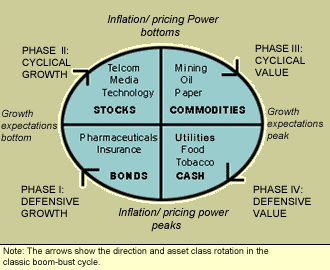
The Investment Cycle

This chart suggesting the various phases of the Investment Cycle was published in 2000. If you think about the run up in the commodities and oil markets over the past 18 months it begs the question; are we approaching the 'growth expectations peak' ?

Wednesday, May 10, 2006

A Chill in the Air

The US property market seems to be rolling over, as this report from Theledger.com suggests.
The Federal reserve are in a difficult position. They are likely to increase interest rates again today in defense of the dollar, but rate tightening is putting pressure on the housing bubble and indebted American consumers. I think this is whats called being caught between a rock and a hard place.

Elsewhere, for the first time in nearly a decade, you can smell the anxiety. The
listing agent for a four-bedroom home on Scripps Trail in San Diego informed
other agents in the multiple-listing service that a "very, very motivated seller
will entertain all reasonable offers" and "will help with closing costs." The
house was listed in September at $810,000. After a previous price cut, the
seller is now willing to entertain offers as low as $685,000.The seller bought
the house for $730,000 in 2005, according to county property records, for what
the listing agent said were investment purposes.

http://www.theledger.com/apps/pbcs.dll/article?AID=/20060509/ZNYT01/605090404/1001/BUSINESS

Monday, May 08, 2006

Sherry Fitzgerald Report Spring 2006

The latest Sherry Fitzgerald Residential Market Report for Spring 2006, published last week, contains the usual sunny appraisal of the future prospects of the housing market. However the report contains truly astonishing information on the composition of buyers of new homes. In the Spring of 2004 Sherry Fitzgerald reported that 57% of new homes were purchased by first time buyers, with investors buying 13%. The latest report has first time buyers buying 33% of new homes, while investors mop up 40% of new home output.

Given that rental growth is flat at best the growth in the investment market is hard to explain.


http://www.sherryfitz.ie/webdataex/articles/278.pdf

Tuesday, May 02, 2006

What's Hot and What's Not


The deflation in property prices in the Spanish Costas continues, largley unheraldeded in the media in Ireland or the UK. The once red hot market, which reached a peak in 2002, is now seldom mentioned (well not in polite conversation). It seems markets in Cyprus and Croatia are feeling the pinch also. Prehaps these forgotten markets illustrate the likley fate of other hotspots which presently consume the attention of the fly to let hoards.


SUR In English

General News

Desperate property owners start to lower asking prices to speed up sales

Almudena Nogüés

Flats are taking 32 months to sell

Some owners are accepting offers 30,000 euros below their original price


After seven year long real estate boom with prices reaching exorbitant levels, sales are starting to slow down. Some owners, tired of seeing the “For Sale” sign outside their home for months on end, are finding themselves selling for sums way below what they had originally hoped for, and sometimes even less than the amount quoted on the official valuation.

Professionals claim that one of the main causes of this present situation is that much of the demand has already been satisfied while other potential buyers have been priced out of the market. The threat of rising interest rates has helped to slow down sales along with the fact that “it would have been impossible to keep up the recent rate of evolution of the market for much longer”, explains the national director of the MC estate agency, Juan Felipe Muñoz. Now it is taking an average of 32 months to sell a property.

While experts are avoiding using the word “crisis”, they admit that those people who bought properties in order to sell them on again are now finding it hard to turn the bricks back into cash. Owners can no longer use the amount fetched by a neighbouring property as a guideline as this “often leads to disappointment”, pointed out the president of the School of Real Estate Agents, Cayetano Rengel. “The time when studios fetched 250,000 euros could not go on forever”, he added.

“Now an owner in a hurry to sell has no choice but to lower the price. Someone asking 300,000 at first might easily drop the price to 230,000 after several months have gone by without finding a buyer”, point out sources from Unicasa. Similarly Juan Carlos Cuevas, the manager of a Tecnocasa franchise, said that he is seeing “brutal cuts” in prices. “It’s quite normal for an owner to drop between 18,000 and 30,000 after less than three months”.

Not contented with the usual classified advertising, owners are also seeking new ways of finding a buyer. Over recently months we have seen an increase in advertisements appearing everywhere, from car windscreens to lampposts and letter boxes.

Meanwhile the Association of Madrid Property Developers and international financial analysts predict that the slump in the market could reduce employment in Spain by two per cent by the middle of 2007 and reduce the Gross Domestic Product by 1.3 per cent.

Monday, May 01, 2006

Boston Boom Ends.

News from the US on the continuing slowdown in the once frenetic housing market.

The Boston Globe has this update. “After five red-hot years, home sales have cooled north of Boston and across the state. Gone are the days of multiple bids, price run-ups, and fast sales. Falling prices, rising inventory, and longer selling periods are now the norm, industry watchers say. ‘We’re at a turning point,’ said John Bitner, chief economist at Eastern Bank of Lynn. ‘The upward movement has definitely turned the other way. It’s a buyer’s market.’”

“Home sales in Massachusetts dropped 8.4 percent from January to March, compared with the same period last year, and 13 percent over the last 14 months, according to a report issued last week by the Warren Group. In March, home sales and prices dropped 1.5 percent, with the average selling price falling to $325,000 from $330,000 in March 2004.”

“The slowdown has left a glut of homes sitting idle, and hundreds of homeowners waiting impatiently for the chance to downsize, trade up, or move closer to family or even out of state for a job. Currently, 2,279 single-family homes are for sale north of Boston, a 48 percent increase over April 2005, when 1,538 homes were listed.”

“Eric and Denise Kerble of Swampscott put their spacious Colonial on the market in January for $399,900, betting it would sell fast in a seaside town where the average price tag on a single family house is at least $100,000 more. Now, after more than 100 days without an offer, the Kerbles have dropped their price to $394,900.”

“The couple paid $206,000 for the gray, 1,586-square-foot house eight years ago, outbidding several other prospective buyers. They said they have since spent more than $25,000 on upgrades.”

“‘We hope this does the trick,’ said Denise Kerble. ‘Lots of people have looked
at it, but nobody takes the next step.’
The Kerbles are one of the many Massachusetts families living in limbo, trapped in a suddenly stagnant real estate market that has forced them to put their dreams on hold.”

“In Middleton, competition from new homes for sale on East Street prompted Patrick and Susan McIntire to drop the price on their Colonial that they first listed at $419,900 in November. The house is priced at $399,900, but still has received no offers.”

‘We don’t want to give our house away,’ said Susan McIntire, who hopes to find
a house with more land in New Hampshire. ‘We’ve put a lot of sweat into it. But
it’s also very frustrating trying to sell a house now. There are more places to
live than people looking to buy.’”

“Local realtors say the falling prices and longer marketing periods show the market has come back down to earth after years of skyrocketing sales. With inventories climbing, sellers no longer can name their asking price. ‘Things are much more realistic now,’ said Claire Dembowski, a broker in Swampscott, who is also the listing agent for the Kerbles’ house. ‘Sellers had the advantage for a long time, but now the cycle is going the other way.’”

Saturday, April 29, 2006

Credit Where It's Due.

The rate of expansion in residential mortgage debt in Ireland is astounding. Figures from the Central Statistics Office show that the rate of growth reached 29.4% in February, with €2.91 billion borrowed. However this is not a record that honour falls to the month of December last, when €3,500,000,000 was borrowed, in one month. That's a hard figure to get your head around, so think about it terms of one Euro coins. A one Euro coin weighs 7.5 grams and has a diameter of 23.25 mm. If the banks doled out mortgage debt in coinage they would have had to transport 26,250 tonnes of it last December alone; enough to fill nine hundred three axel trucks. Laid side to side 3,500,000,000 Euro coins would stretch around the globe a little over twice.


While the monthly mortgage debt creation figures are breathtaking, the rate at which this debt is growing is mind-boggling. As house prices rise the amount of debt required to buy increases. In 2002 the rate of growth was 11%; in 2003 12.9% , in 2004 23%, in 2005 26% and the latest figure for this year is 29.4%. As the debt rises ever higher the trajectory steepens more and more.

Thursday, April 27, 2006

House Price Inflation Highest Since 2000

The latest TSB/ERSI House price index released today shows house prices rising at their fastest rate since 2000. The rise expressed as a percentage is a fairly useless statistic as people are paid in Euros not percentages. The monthly rate for March nonetheless was 1.3% , and a spokesman for the TSB suggested that inflation will moderate later in the year. (he hopes)

Ironic that the vested interests always refer to the non-occurrence of a crash as evidence that the bear case is flawed. It could equally be said that the much vaunted soft landing is pretty conspicuous by it's absence.


http://www.rte.ie/business/2006/0427/houses.html

Wednesday, April 26, 2006

Jens Lehmann Bust my Bubble.

The German economy is starting to see the stirrings of recovery. The IFO German business confidence survey reached a fifteen year high in March. The rise in business confidence is reflected in the rate of German inflation at 2.3% for April, in excess of the 2.00% most commentators expected. In France business confidence has also risen, an index measuring sentiment among French manufacturers increased to 108 in April, the highest since March 2001, acording to Paris- based statistics office Insee. (The German and French economies account for about half of the $9.4 trillion Euro Area economy.)

So it’s springtime for France and Germany, and for the supply of Euros, as the ECB announced currency in circulation grew at an annual rate of 13.6 per cent in February. How is the ECB viewing this?,
Well M. Trichet’s was heard to remark yesterday;

‘we have to remain credible with whatever risks we have to cope with’

`it's obvious that there are risks to price stability in the euro region,''

ECB council member Axel Weber said in an interview yesterday in the Frankfurter Allgemeine Zeitung. Inflation risks such as oil prices and money-supply growth
``make a normalization of the benchmark interest rate level seem to be in order.''

‘We have to remain credible’, ‘normalization of the benchmark interest rate level’ Translated into pounds shillings and pence; ‘we will increase the cost of borrowing’ The current Euro base rate is 2.5%, commentators now expect that rates will increase twice more to 3.25% by the end of the year. However the tempo and level to which rates will rise depends on a number of factors, including the inflationary impact of oil price rises and improving consumer sentiment in Germany.
That’s where Jens Lehman comes in, if he repeats the heroics of last night, (saving a penalty in the last minutes of the European Cup semi’s) in the World cup final against say Brazil. Well the ‘over the moon’ German zeitgeist, might send consumer confidence soaring.

Tuesday, April 25, 2006

Irish Property Bubble

I decided to start this blog, dealing with the Irish property market, for a number of reasons and with specific goals in mind.

1. The state of the property market is a topic which attracts considerable attention, in the established media, in day to day conversation and on the internet. As no dedicated forum currently exists to discuss this hottest of hot topics, I’ve set up this blog.

2. I’m conscious that much of the media coverage in Ireland of the property market is unquestioning of the benefits of the unprecedented inflation in prices. I am also aware that many people are troubled about, both the sustainability of current property prices and wider economic and societal issues, which in whole or part can be attributed to the boom.

3. Quantifying the variables and identifying the metrics required to measure the performance of the Irish property market is difficult. Other property markets, notably the American, benefit from an abundance of statistics. In an ideal world we would have easy access to transaction evidence, sales prices, volumes, buyer type data and rental values etc. All of this information is currently collected by government and financial institutions; however accessing the data is not easy. I would hope that this forum would act as a receptacle for sources and a medium for publishing and discussing the same.


4. Finally I hope that this forum will attract sufficient interest to allow us to make it a source for contributors from as wide a source as possible. With that in mind I’m hopeful that others will be willing to add their insight and knowledge.