Friday, February 23, 2007

The Wave


Capturing something as indistinct and slippery as the public mood is difficult. But catching the fleeting moment when that mood changes is much more challenging.

Hunter S Thompson the American writer and originator of all things Gonzo, was particularly proud of this piece of writing which he described as; “probably the best thing I’ve written” He was right to be proud. He describes the feel good zenith of the San Francisco Hippie zeitgeist beautifully.


San Francisco in the middle sixties was a very special time and place to be a part of. Maybe it meant something. Maybe not, in the long run . . . but no explanation, no mix of words or music or memories can touch that sense of knowing that you were there and alive in that corner of time and the world. Whatever it meant. . . .

History is hard to know, because of all the hired bullshit, but even without being sure of "history" it seems entirely reasonable to think that every now and then the energy of a whole generation comes to a head in a long fine flash, for reasons that nobody really understands at the time — and which never explain, in retrospect, what actually happened........

There was madness in any direction, at any hour. If not across the Bay, then up the Golden Gate or down 101 to Los Altos or La Honda. . . . You could strike sparks anywhere. There was a fantastic universal sense that whatever we were doing was right, that we were winning. . . .

And that, I think, was the handle — that sense of inevitable victory over the forces of Old and Evil. Not in any mean or military sense; we didn’t need that. Our energy would simply prevail. There was no point in fighting — on our side or theirs. We had all the momentum; we were riding the crest of a high and beautiful wave. . . .

So now, less than five years later, you can go up on a steep hill in Las Vegas and look West, and with the right kind of eyes you can almost see the high-water mark — that place where the wave finally broke and rolled back.
Hunter S. Thompson Fear and Loathing in Las Vegas
At this juncture in the deflation of the Great Irish Property Bubble it is of course difficult to gauge the zeitgeist. But I think it is changing; and a few years from now it may be possible to look back at this time and see where the wave of folly and greed finally broke and rolled back.


Monday, February 19, 2007

Sign of the Times

The much heralded soft landing for the Irish property market is happening right now, according to the banks; the estate agents and Damien Kiberd. That being the case we have an opportunity here folks to witness something that has never, ever occurred in economic history, a soft landing after a prolonged period of rampant speculation in an asset class. So put on the kettle pull up a chair, make yourself comfortable and watch, a never to be repeated, inconceivable (until now) first.
But ah……before you get too comfortable in that chair, I have a confession to make (hangs head). It shames me to admit this but… when I first heard of the prophecy, that an economic miracle was to be bestowed upon this island, I was just a tiny weenie bit cynical. But not for long mind you. I know, I know. How I could possibly question a revelation bestowed on an assortment of estate agents, bankers and Damien Kiberd?. Please allow me to explain my fleeting moment of doubt. You see, I foolishly thought that the old rules of supply and demand still applied, I thought that the Irish were about as indebted as any nation could prudently get; and then some. I looked at the number of empty homes in the country (250,000) and thought, we have sufficient of the houses. Ha ha ha, I laugh now at my foolishness. Oh were it that that was the end of my irreligious uncertainty. You see I thought (don’t ask me why) that in the new ferociously competitive global economy that Ireland’s falling competitiveness would effect our ability to procure and keep high earning productive jobs, I thought that the liquidity gusher that is the Japanese Yen carry trade was unsustainable, I had a notion that rising interest rates and falling real incomes growth might hinder rather than help. I even looked at property markets abroad where prices are falling and mortgage lenders and estate agents are going bust, and thought (please don’t laugh) that this might be instructive.
But mercifully, thankfully I banished these wicked feelings that prevented me from seeing the blinding light that so fortuitously shone upon some bankers, Damien Kiberd and several estate agents. Verily they have been to the top of the market and they have seen the Promised Land (bank).

Ps
The only people busy in the Irish market at the moment are the FOR SALE sign makers. The lads have most of their stock sitting in gardens the length and breadth of the country. You see, when the market was busy they would stick up an agents FOR SALE sign then a few weeks later return and stick a SOLD slip over the FOR SALE bit and then after the new owners had moved in return one last time to remove the sign for good. Not anymore. The sign makers routine has been disrupted of late by the softly softly market . Its no longer erect sign, sold slip, remove sign, its more; erect sign, erect sign, erect sign, erect sign of another agent beside the one for the first agent that you put up couple of months ago.

The sign makers are busy making new signs, as their existing supply ineffectually just stands there, weathering.

Sunday, January 07, 2007

Media Bears

The media seem to have emerged from the Christmas period like a bear with a sore head in their reporting of the Irish property market. Even The Irish Times the self styled organ of record, and a fervent housing bubble denier has allowed one, less than wholly enthused about things, observation on the venal grand illusion. But this week’s prize for bearishness goes to The Sunday Times and this leading editorial;

Our habit of throwing money around like it’s going out of fashion has only been reinforced by the dawning realisation that a slowdown in the property market may mark the beginning of an end of an era. The construction industry has been the engine of the Irish boom, and the levelling off of prices in recent months will have negative knock-on effects elsewhere in the economy. While there is no evidence yet of a freefall in property values, the possibility of price plunges and an accompanying collapse in house-building activity remains very real, with potentially devastating results.

The prospect of at least two further interest-rate rises before the election will also dampen sentiment in a market that has become notably less bullish in the past year. Always a background preoccupation, the fate of property values is likely to become an even greater popular obsession in 2007.

While house price rises have faded, inflation seems set to become the other defining feature of the year ahead. Provisional estimates suggest our inflation rate is likely to rise from 4.4% to 6% in the short term, and a further destabilising climb cannot be ruled out……..
We are embarking on a period of considerable challenge and no little uncertainty. As the election approaches, voters will have much to contemplate. The game is on, and it’s all to play for.

http://www.timesonline.co.uk/article/0,,2091-2534646,00.html

Wednesday, December 13, 2006

Now Is The Season.

The autumn property selling season has ended. It was a selling season like no other, due to the fact that very little actual selling took place. The once hectic auction rooms are quite now, apart from the occasional stirrings of dispirited ghost bidders; across the land a multitude of hopeful For Sale signs are buffeted by depression driven winds from across the Atlantic. The market’s melancholy mood is indeed strikingly removed, from the hectic exuberance of blooming springtime.

The banks, auctioneers and the government like dutiful doctors fuss about the ailing market; variously offering comforting words, tinctures of interest relief and placebo like soft landings. But what is remarkable about the vested interests reaction to the utterly inevitable is their zealous denial. Denial in the face world beating indebtedness; rising interest rates, a glut of supply, ‘relaxed’ (to the point of comatose) lending standards and a collapsing real estate market in the United States.

But while I am surprised by this denial, I understand it. The bursting of the property bubble will do damage to this country, as have other speculative property market ‘corrections’ in other countries. Nevertheless, that the bubble was allowed to reach such epic proportions, that’s its bursting will cause misery, is much more than unfortunate.

Tuesday, November 14, 2006

Market Roller Coaster of the Mind


Essentially a road map of what we are likely to witness as a nation over the coming months this handy chart is an excellent guide to market psychology from boom to bust. I think the market in general is somewhere between Euphoria and Anxiety, however some of the better informed market participants are probably firmly in the Denial stage. My guess is that the Denial stage in the broader market will arrive sometime in the Spring selling season.

Sunday, November 12, 2006

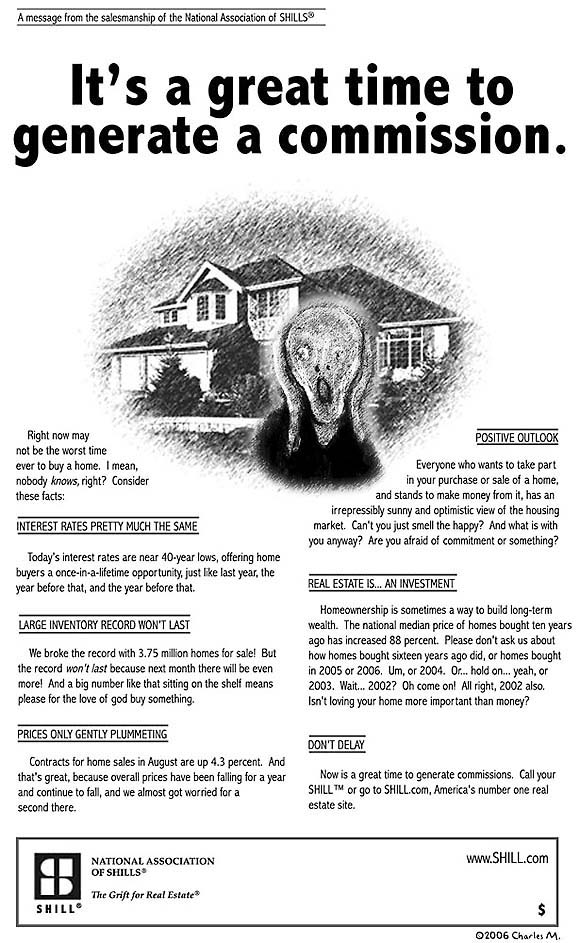
Its a great time to get a commission.


Click to enlarge this parody of the American National Association of Realtors latest advertising campaign. The campaign is entitled It's a great time to buy or sell. But can it be both a great time to sell and a great time to buy?

Thursday, November 09, 2006

The Bubble has Landed

The South East region of England is one of the wealthiest and most densely populated areas in Europe. Agricultural land values in the region reflect its affluent, metropolitan nature, an acre of arable in the Home Counties will cost you £5,429, £2,000 more than an acre of the green stuff in North East England or Scotland. However an acre of land in the South East is cheap as chips in comparison to land in Northern Ireland. An acre of land in the North will set you back a whopping (fanfare)……… £9,750. As far as I’m aware Northern Irish land is no more productive than land in Surrey, Hampshire or Kent. Northern farmers (to the best of my knowledge) haven’t taken to growing fields of poppies or marijuana, so why the hefty price differential. Could it be the spread of that rampant disease, bubbleitis from south of the border?

If you want more information on of the more bizarre side effects of the Irish Property Bubble, check out this link to The Valuation Office Agency in the UK.

http://www.voa.gov.uk/publications/property_market_report/pmr-jul-06/index.htm

Monday, October 30, 2006

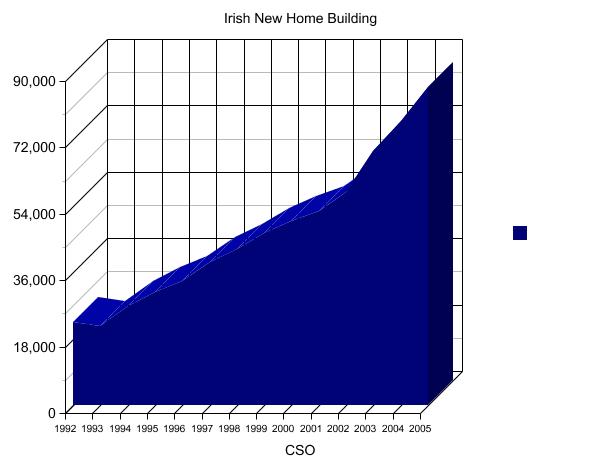
New Home Building


We are probably building many more new homes than we need. 15% of the housing stock is empty and rental yields are scraping 2-3%. Its surprising that we should have this massive excess of supply at a time when the Irish population is growing so rapidly; with the influx of migrants who have come to our shores to serve us in shops and restaurants and .... aah.... build houses.

Monday, October 23, 2006

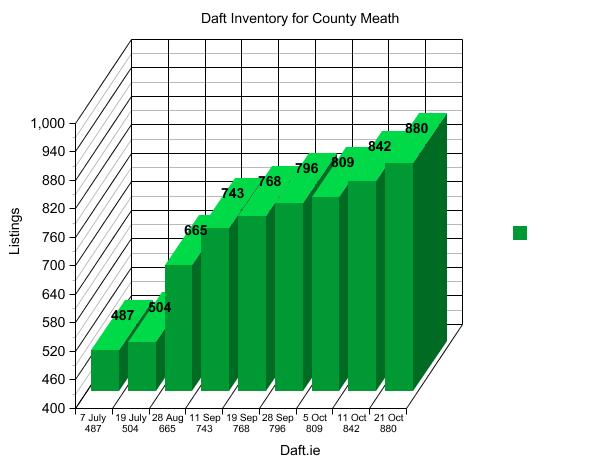
Daft Inventory Meath


The supply of homes for sale continues to grow during the peak selling season in County Meath.

Tuesday, October 10, 2006

iamfacingforeclosure.com

"I'm a 24-year-old aspiring real estate investor from Sacramento CA. After going to few seminars I bought 8 houses in 8 months across 4 states with no money down. I fixed and sold 2 and then ran out of cash. I am now facing foreclosure on 5 houses. I'm learning my lessons, finding solutions and blogging about it. Comments appreciated!"

This guy and the mess he finds himself in is attracting a lot of attention in the blogosphere.
He’s stopped taking calls from the banks he owes money because he doesn’t like their bad attitude. He is presently hatching a dastardly and highly convoluted scheme to dump the properties he bought on unsuspecting ‘credit challenged buyers’. Oh and how did he find himself with all this property in the first place? He committed several criminal frauds in obtaining mortgages. And faces the unsavory possibility of some hard time (several years) in what the Americans call the ‘Big House’.


http://iamfacingforeclosure.com/

Wednesday, October 04, 2006

Vacant

The number of vacant housing units in the US (9.1% of total stock) is at it's highest since 1960 (when records began). In Ireland the number of vacant units is somewhere in the region of 15%, (according to figures from the CSO) The vacancy rate in the UK is roughly 3% of housing stock. Have we repealed the laws of supply and demand in Ireland? Or are we witnessing one of the greatest speculative asset bubbles in European history?

http://www.census.gov

Wednesday, September 27, 2006

So, Said Fred..


"To combat the depression by a forced credit expansion is to attempt to cure the evil by the very means which brought it about; because we are suffering from a misdirection of production, we want to create further misdirection - a procedure which can only lead to a much more severe crisis as soon as the credit expansion comes to an end." - Friedrich Hayek 1933

Enough said Fred.

Imagine if Hayek was alive today; looking for a concrete (or timber framed) example to support his thesis that curing a debt binge with more debt was a bad idea. Where oh where would he find a debt engrossed 'guinea pig' to observe,..... no don't tell me... its on the tip of my tongue.

Wednesday, September 13, 2006

Are Youze Talking To Us?

Jean-Claude Trichet, president of the ECB, suggested last week that the Irish housing market was ‘abnormal’. Abnormal hey?; abnormal sez he, abnormal is it? Why that jumped up little cheese eating surrender monkey! And to add insult to injury a shower of yahoos be the name of Fitch Ratings sez that, we should keep a look out for "macro-prudential stress”. Oi’ll give dem macro-prudential stress, so Oi will. Why cant all these spalpeens away and feck off. I’m off for a good f**kin read of Ireland's Own.

The rating agency Fitch said it now has five countries on watch for
"macro-prudential stress", up from two last year, using a set of indicators. A
mixed bag, they comprise Iceland, Azerbaijan, South Africa, Russia and,
surprisingly, Ireland, where the ratio of private credit to GDP has reached
190pc, the world's highest. The denouement for Ireland may not be pretty, since
it gave up control of monetary policy when it joined the euro.
Richard Fox, the author of the Fitch report, said: "We're still in a global upswing but this lending cycle is already starting to turn in some countries. Credit growth has
been zooming across the whole of Eastern Europe and that has tended to be a
precursor to banking troubles."

http://www.telegraph.co.uk/money/main.jhtml?xml=/money/2006/09/12/cctrade12.xml

Saturday, August 05, 2006

The Madness of Crowds


In reading the history of nations, we find that, like individuals, they have their whims and their peculiarities; their seasons of excitement and recklessness, when they care not what they do. We find that whole communities suddenly fix their minds upon one object, and go mad in its pursuit; that millions of people become simultaneously impressed with one delusion, and run after it, till their attention is caught by some new folly more captivating than the first. We see one nation suddenly seized, from its highest to its lowest members, with a fierce desire of military glory; another as suddenly becoming crazed upon a religious scruple, and neither of them recovering its senses until it has shed rivers of blood and sowed a harvest of groans and tears, to be reaped by its posterity.

The one constant in this world is human nature.

http://www.litrix.com/madraven/madne001.htm

Friday, August 04, 2006

A Must Read Study Study of International Housing Markets

Between 1979 and 1995 house prices in Ireland did not rise in real terms. House prices in Germany have fallen for twenty five years, in New Zealand for thirty years and in Japan, The US and Australia prices have fallen in real terms for 35 years. These and other fascinating facts can be found in a US Federal Reserve Study of international housing markets.


We find that real house prices are pro-cyclical and tend to reach a maximum near business cycle peaks, often after a prolonged period of buoyant growth in activity has raised output above its potential level and inflation pressures have begun to emerge. Subsequently, real house prices fall for about five years and their previous run-up is largely reversed. Real GDP growth slows during the first year or so after house prices peak as do growth rates of private consumption and investment.

House price booms are typically preceded by a period of easing monetary policy with rates bottoming out about three years before house prices peak. Rates then reverse quickly (after the peak) in response to falling GDP growth


House Prices and Monetary Policy: A Cross-Country Study1. The 65-page treatise covers 35 years and housing cycles in 18 different countries including Ireland.

Tuesday, July 25, 2006

Of Interest Only

This report from todays Indo, on growing concerns of the consequences of lax lending by Irish Banks.
A MORTGAGE crisis is looming for first-time buyers over the aggressive marketing of interest-only and 100pc mortgages by banks and building societies, the Consumers' Association said yesterday.
Figures in a research report by Davy Stockbrokers estimated recently that up to four out of every 10 mortgages sold to first-time buyers are now 100pc homeloans. The report also found that the average first-time buyer was being offered a 35-year mortgage in a bid to counteract rapidly rising housing prices.

Yesterday, chief executive of the Consumers' Association Dermott Jewell said the promotion of 100pc and interest-only mortgages was "dangerous and an accident waiting to happen". "We were promised by the financial industry when these products were introduced that they would only be offered to a certain few. That is certainly not the case now."
The words closing, stable, and door spring to mind. Ho hum.

Tuesday, July 11, 2006

A Miscellany of Housing Stats

Housing Completions

1998 42,000
1999 45,000
2000 48,000
2001 52,000
2002 56,000
2003 66,000
2004 75,000
2005 81,000
2006 100,000 (est)

Housing Loan Approvals

2000 80,858
2001 69,062
2002 93,136
2003 97,888
2004 104,305
2005 120,637

The Sixth Housing Land Availability Survey June 2004.

12,500 hectares of zoned serviced land in the state with an estimated yield of 367,000 housing units.

National House Building Cost Index 2004.

2.8% year on year. Below general Inflation.


Sources: (CSO, DOE)

Monday, July 10, 2006

Extreme Home Staging

It seems Americans are hard wired to produce the tawdriest marketing schmaltz conceivable.
But this story of ‘extreme home staging’ is so gag worthy that I’m almost reluctant to repeat it here. So if anyone has a particular aversion to ‘lifestyle’ peddling, please navigate away from this blog, you have been warned.


NEW YORK (CNNMoney.com) -- Home sellers long ago discovered that small touches could boost selling prices - fresh flowers, the smell of freshly baked cookies. Now a real estate developer, Centex of Dallas, is adding in beautiful people.

The experiment in what's called "staging" is simple: Home buyers enter a home and see not just furniture but real people - actors - playing out the life they might lead there. "Staged model homes tend to be sterile and dry - this was a way to put the heartbeat back into the home," said Jim Garfield, spokesman for Roddan Paolucci Roddan, Centex's publicist.

In one performance, the 'model' family spent about three hours pretending it was Mom's birthday. They baked a cake, sang happy birthday and the children drew and framed a picture - of a Centex house. The original cast included a former Baywatch hunk, Jaason Simmons, in the role of Dad.

"It's physically manifesting somebody's dream," said Garfield.

Amanda Larson, a marketing director for Centex, says the idea came about when she sat down with Roddan's creative people and worked out an idea to make the visiting-a-model-home experience "more interactive and more
memorable."

I warned you didn’t I.
This ‘extreme home staging’ will no doubt hit our shores as the market slows. Expect to encounter actors in pristine show homes in Mullingar, possibly partaking in a game of familial Monopoly, the child exclaiming, ‘Mammy, Daddy I landed on the Glens Executive Housing Development in Mullingar, I’ve won, I’ve won!’

Thursday, July 06, 2006

No Iceland, not Ireland.


The Financial Times reports on the troubled economy of an island nation in the North Atlantic.

Geir Haarde, Iceland's new prime minister plans to cool his country's overheating economy with a series of reforms aimed at ensuring that the island-nation avoids a hard landing. The comprehensive action plan includes measures to tame a booming housing market, curb wage inflation, improve financial regulation and rein in public spending. "We have given ourselves some breathing space," he told the FT.

Iceland has been the focus of international attention since February when investors, including many hedge funds, concluded the economy was dangerously overheating and withdrew funds, triggering a 30 per cent depreciation in the currency.

Fears of an economic meltdown have since dissipated. But the central bank acknowledges that growth will "go down rather quickly" next year and external economic developments could still trigger a sharper-than-expected correction. The economic boom was driven by the liberalisation of the housing market, tax reductions and overseas investment in power and aluminum projects. The effects of these factors were exaggerated due to the small size of the economy of Iceland which has a population of just 300,000.

As part of his reform package, Mr Haarde, has reduced the amount the Housing Finance Corporation - a state owned body that controls around 40 per cent of the mortgage market - is able to lend to borrowers. He is considering abolishing it in future, he said.

The prime minister has separately reached an agreement with unions to moderate wage claims and end a policy of broad tax reductions and replace it with a reallocation of tax benefits to the less wealthy. Mr Haarde has also halted government spending on some infrastructure projects and is prepared to suspend future spending if needed, he said.


http://www.ft.com/cms/s/0e635268-0c8b-11db-8235-0000779e2340.html