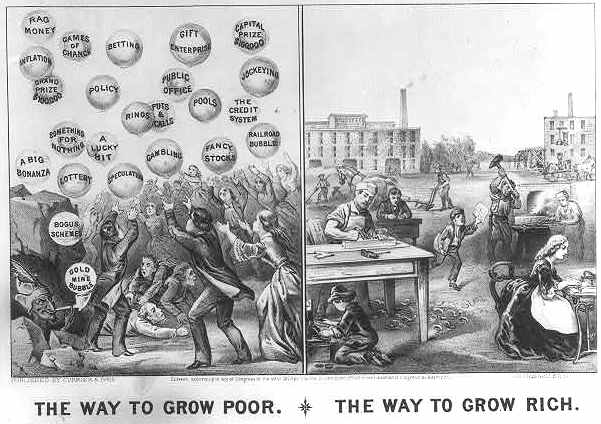
Essentially a road map of what we are likely to witness as a nation over the coming months this handy chart is an excellent guide to market psychology from boom to bust. I think the market in general is somewhere between Euphoria and Anxiety, however some of the better informed market participants are probably firmly in the Denial stage. My guess is that the Denial stage in the broader market will arrive sometime in the Spring selling season.
Tuesday, November 14, 2006
Market Roller Coaster of the Mind
Essentially a road map of what we are likely to witness as a nation over the coming months this handy chart is an excellent guide to market psychology from boom to bust. I think the market in general is somewhere between Euphoria and Anxiety, however some of the better informed market participants are probably firmly in the Denial stage. My guess is that the Denial stage in the broader market will arrive sometime in the Spring selling season.
Sunday, November 12, 2006
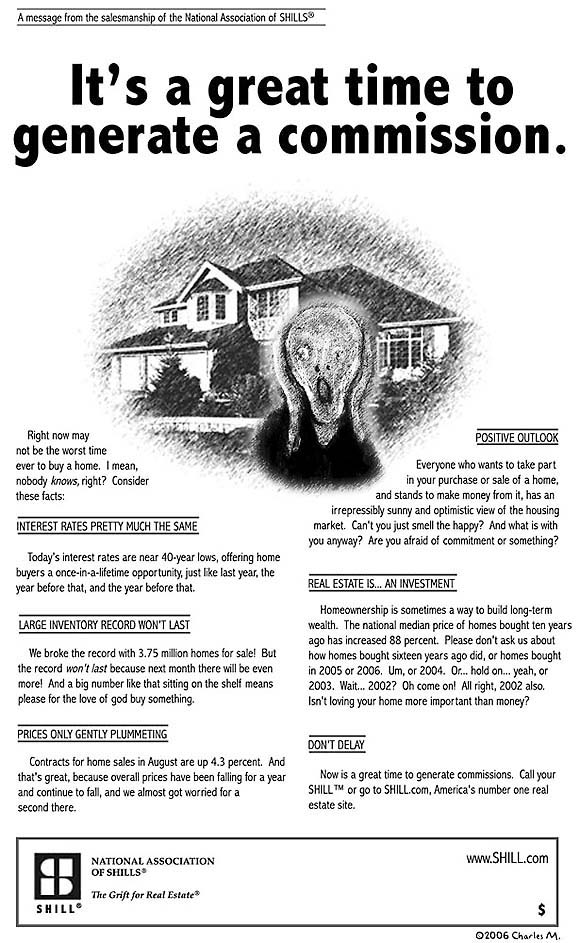
Its a great time to get a commission.
Thursday, November 09, 2006
The Bubble has Landed
If you want more information on of the more bizarre side effects of the Irish Property Bubble, check out this link to The Valuation Office Agency in the UK.
http://www.voa.gov.uk/publications/property_market_report/pmr-jul-06/index.htm
Monday, October 30, 2006
New Home Building

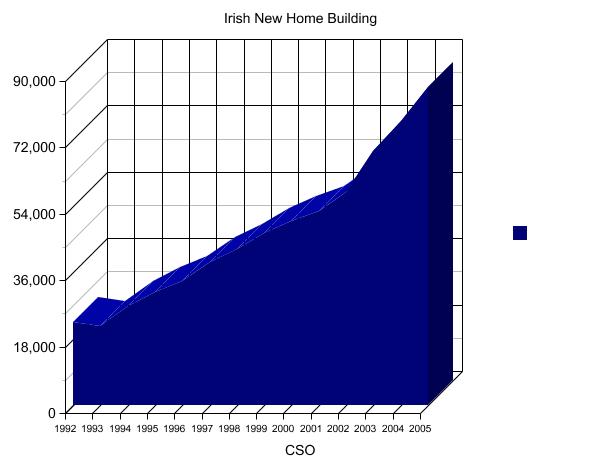
We are probably building many more new homes than we need. 15% of the housing stock is empty and rental yields are scraping 2-3%. Its surprising that we should have this massive excess of supply at a time when the Irish population is growing so rapidly; with the influx of migrants who have come to our shores to serve us in shops and restaurants and .... aah.... build houses.
Monday, October 23, 2006
Tuesday, October 10, 2006
iamfacingforeclosure.com
This guy and the mess he finds himself in is attracting a lot of attention in the blogosphere.
He’s stopped taking calls from the banks he owes money because he doesn’t like their bad attitude. He is presently hatching a dastardly and highly convoluted scheme to dump the properties he bought on unsuspecting ‘credit challenged buyers’. Oh and how did he find himself with all this property in the first place? He committed several criminal frauds in obtaining mortgages. And faces the unsavory possibility of some hard time (several years) in what the Americans call the ‘Big House’.
http://iamfacingforeclosure.com/
Wednesday, October 04, 2006
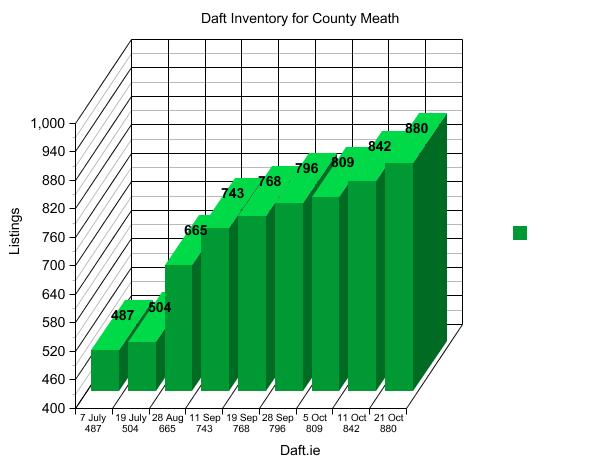
Vacant
http://www.census.gov
Wednesday, September 27, 2006
So, Said Fred..
"To combat the depression by a forced credit expansion is to attempt to cure the evil by the very means which brought it about; because we are suffering from a misdirection of production, we want to create further misdirection - a procedure which can only lead to a much more severe crisis as soon as the credit expansion comes to an end." - Friedrich Hayek 1933
Enough said Fred.
Imagine if Hayek was alive today; looking for a concrete (or timber framed) example to support his thesis that curing a debt binge with more debt was a bad idea. Where oh where would he find a debt engrossed 'guinea pig' to observe,..... no don't tell me... its on the tip of my tongue.
Saturday, September 23, 2006
Wednesday, September 13, 2006
Are Youze Talking To Us?
http://www.telegraph.co.uk/money/main.jhtml?xml=/money/2006/09/12/cctrade12.xmlThe rating agency Fitch said it now has five countries on watch for
"macro-prudential stress", up from two last year, using a set of indicators. A
mixed bag, they comprise Iceland, Azerbaijan, South Africa, Russia and,
surprisingly, Ireland, where the ratio of private credit to GDP has reached
190pc, the world's highest. The denouement for Ireland may not be pretty, since
it gave up control of monetary policy when it joined the euro.
Richard Fox, the author of the Fitch report, said: "We're still in a global upswing but this lending cycle is already starting to turn in some countries. Credit growth has
been zooming across the whole of Eastern Europe and that has tended to be a
precursor to banking troubles."
Saturday, August 05, 2006
The Madness of Crowds
In reading the history of nations, we find that, like individuals, they have their whims and their peculiarities; their seasons of excitement and recklessness, when they care not what they do. We find that whole communities suddenly fix their minds upon one object, and go mad in its pursuit; that millions of people become simultaneously impressed with one delusion, and run after it, till their attention is caught by some new folly more captivating than the first. We see one nation suddenly seized, from its highest to its lowest members, with a fierce desire of military glory; another as suddenly becoming crazed upon a religious scruple, and neither of them recovering its senses until it has shed rivers of blood and sowed a harvest of groans and tears, to be reaped by its posterity.
The one constant in this world is human nature.
http://www.litrix.com/madraven/madne001.htm
Friday, August 04, 2006
A Must Read Study Study of International Housing Markets
House price booms are typically preceded by a period of easing monetary policy with rates bottoming out about three years before house prices peak. Rates then reverse quickly (after the peak) in response to falling GDP growth
House Prices and Monetary Policy: A Cross-Country Study1. The 65-page treatise covers 35 years and housing cycles in 18 different countries including Ireland.
Tuesday, July 25, 2006
Of Interest Only
A MORTGAGE crisis is looming for first-time buyers over the aggressive marketing of interest-only and 100pc mortgages by banks and building societies, the Consumers' Association said yesterday.Figures in a research report by Davy Stockbrokers estimated recently that up to four out of every 10 mortgages sold to first-time buyers are now 100pc homeloans. The report also found that the average first-time buyer was being offered a 35-year mortgage in a bid to counteract rapidly rising housing prices.
Yesterday, chief executive of the Consumers' Association Dermott Jewell said the promotion of 100pc and interest-only mortgages was "dangerous and an accident waiting to happen". "We were promised by the financial industry when these products were introduced that they would only be offered to a certain few. That is certainly not the case now."
Tuesday, July 11, 2006
A Miscellany of Housing Stats
1998 42,000
1999 45,000
2000 48,000
2001 52,000
2002 56,000
2003 66,000
2004 75,000
2005 81,000
2006 100,000 (est)
Housing Loan Approvals
2000 80,858
2001 69,062
2002 93,136
2003 97,888
2004 104,305
2005 120,637
The Sixth Housing Land Availability Survey June 2004.
12,500 hectares of zoned serviced land in the state with an estimated yield of 367,000 housing units.
National House Building Cost Index 2004.
2.8% year on year. Below general Inflation.
Sources: (CSO, DOE)
Monday, July 10, 2006
Extreme Home Staging
But this story of ‘extreme home staging’ is so gag worthy that I’m almost reluctant to repeat it here. So if anyone has a particular aversion to ‘lifestyle’ peddling, please navigate away from this blog, you have been warned.
NEW YORK (CNNMoney.com) -- Home sellers long ago discovered that small touches could boost selling prices - fresh flowers, the smell of freshly baked cookies. Now a real estate developer, Centex of Dallas, is adding in beautiful people.
The experiment in what's called "staging" is simple: Home buyers enter a home and see not just furniture but real people - actors - playing out the life they might lead there. "Staged model homes tend to be sterile and dry - this was a way to put the heartbeat back into the home," said Jim Garfield, spokesman for Roddan Paolucci Roddan, Centex's publicist.
In one performance, the 'model' family spent about three hours pretending it was Mom's birthday. They baked a cake, sang happy birthday and the children drew and framed a picture - of a Centex house. The original cast included a former Baywatch hunk, Jaason Simmons, in the role of Dad.
"It's physically manifesting somebody's dream," said Garfield.
Amanda Larson, a marketing director for Centex, says the idea came about when she sat down with Roddan's creative people and worked out an idea to make the visiting-a-model-home experience "more interactive and more
memorable."
I warned you didn’t I.
Thursday, July 06, 2006
No Iceland, not Ireland.
Iceland has been the focus of international attention since February when investors, including many hedge funds, concluded the economy was dangerously overheating and withdrew funds, triggering a 30 per cent depreciation in the currency.
Fears of an economic meltdown have since dissipated. But the central bank acknowledges that growth will "go down rather quickly" next year and external economic developments could still trigger a sharper-than-expected correction. The economic boom was driven by the liberalisation of the housing market, tax reductions and overseas investment in power and aluminum projects. The effects of these factors were exaggerated due to the small size of the economy of Iceland which has a population of just 300,000.
As part of his reform package, Mr Haarde, has reduced the amount the Housing Finance Corporation - a state owned body that controls around 40 per cent of the mortgage market - is able to lend to borrowers. He is considering abolishing it in future, he said.
The prime minister has separately reached an agreement with unions to moderate wage claims and end a policy of broad tax reductions and replace it with a reallocation of tax benefits to the less wealthy. Mr Haarde has also halted government spending on some infrastructure projects and is prepared to suspend future spending if needed, he said.
http://www.ft.com/cms/s/0e635268-0c8b-11db-8235-0000779e2340.html
Wednesday, July 05, 2006
Tech Bubble Looks Like a Picnic
The Wall Street Journal has this interview with Kenneth Heebner. “To get a lay of the land, we tracked down Kenneth Heebner, who since 1994 has managed the $1.2 billion CGM Realty Fund. It has the best 10-year record of all real-estate-focused mutual funds, according to fund tracker Lipper Inc.”
“WSJ: How is the housing market? Mr. Heebner: A significant decline in prices is coming. A huge buildup of inventories is taking place, and then we’re going to see a major [retrenchment] in hot markets in California, Arizona, Florida and up the East Coast. These markets could fall 50% from their peaks.”
“WSJ: What has you so concerned? Mr. Heebner: I’m worried that more people will default on their mortgages. Risky mortgages..have been widely used in the last two years. Some people got 100% financing for their homes. It made the tech bubble look like a picnic.”
“As housing prices fall more people will be under water, and these people are just going to walk away from their homes. They are going to say, ‘I’m outta here.’ You’re going to see increasing foreclosures over the next several years. As [home] prices come down, it will create a difficult environment for home builders.”
“WSJ: What data have you most worried? Mr. Heebner: We’re seeing a huge increase in inventories of unsold homes. The role of incentives in selling a home is increasing so the weakness doesn’t show up immediately in list prices. Large price declines will follow in inflated markets.”
PRTB ?
At the end of 2005, the number of registrations with the PRTB was 83,983 and this was in respect of 53,070 landlords and 150,518 tenants. At 3 March 2006, the number of registrations with the PRTB was 88,593 and this was in respect of 55,685 landlords and 160,251 tenants.
So, as far as the government is concerned, out of an Irish population of 4,200,000, only 160,000 are private sector tenants. Only 88,593 private sector rental properties exist in the state, about 7-8% of the housing stock. When you consider that agents believe that investors purchase roughly 40% of new build output, (running at 80,000 units currently) the disparity between the PRTB’s figures and the probable actuality is remarkable.
There is something remiss in the Irish property market, we have tens of thousands of empty homes, and a private rented sector that barley exists (statistically). Poor Bertie Ahern is labouring in a qualitative information desert, hence his bad tempered fits when pressed on the issue of Irish housing. Shirty Bertie hasn’t a notion, no one has.
http://www.prtb.ie/pubregfStats.htm
http://www.prtb.ie/pubregister.htm
The second link provides a county by county breakdown of PRTB registered properties.
Friday, June 30, 2006
Global Property Cycle Turning
“‘Due to deflation shocks, global inflation has been low, which allowed major central banks to keep interest rates very low, in turn fueling property,’ economist Andy Xie said. ‘As inflation picks up simultaneously around the world, interest rates are rising everywhere, and the property boom is turning into a bust.’”
“Unlike in previous property cycles, Xie said institutional property investors have been active in shifting capital between different cities, leading to the rare situation where prices gained in unison around the world.”
“‘Innovations in the global financial system have led to a rising correlation of property markets to each other and central bank-policies. It has essentially turned deflationary shocks of the past 10 years into a global property bubble,’ Xie said.”
“He cites some telling statistics to illustrate his point. The value of U.S. housing has risen to 173% of gross domestic product in 2005 from 135% in 2000. And in Australia, housing values rose to 347% of GDP in 2005 from 271% in 2000.”
Wednesday, June 28, 2006
Bollywood does Banks
http://www.grapheine.com/bombaytv/play_uk.php?id=724918